
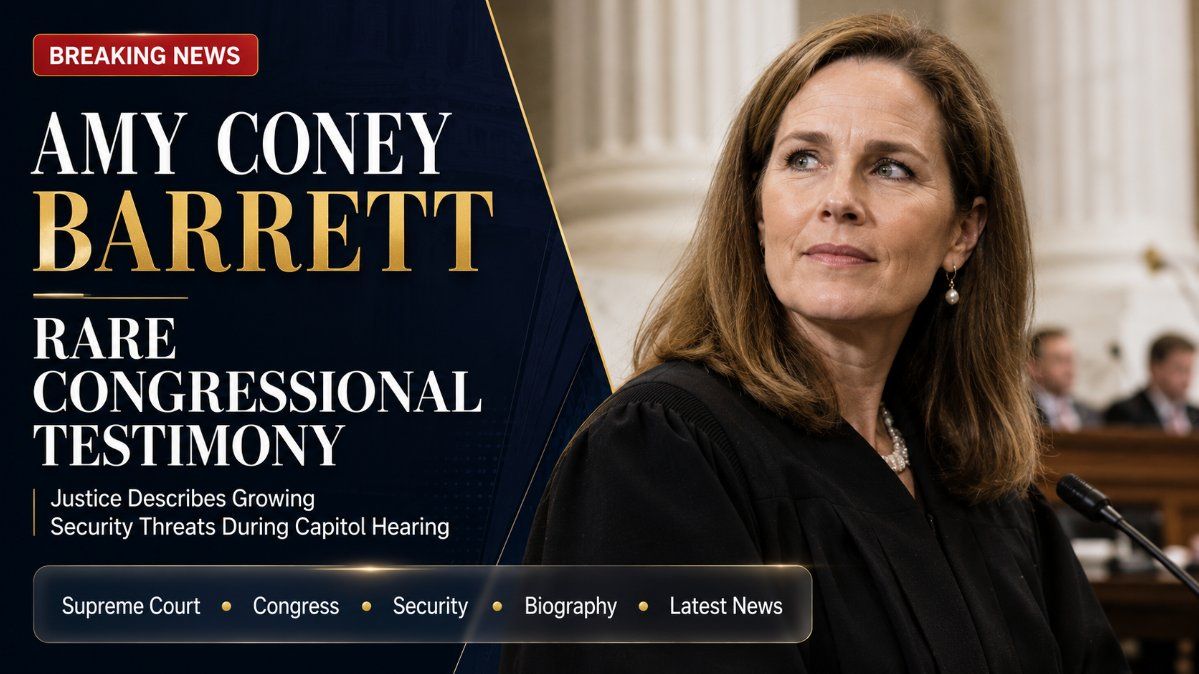
Amy Coney Barrett Biography (2026): Supreme Court Testimony, Security Concerns, Latest News, Career & More
Discover Amy Coney Barrett's 2026 biography, Supreme Court testimony, latest news, judicial career, education, family, and key achievements.
Amy Coney Barrett remains one of the most influential figures on the United States Supreme Court, playing a central role in many of the nation's most closely watched constitutional cases. Since joining the Court in 2020, Barrett has become one of its best-known justices, attracting attention for her judicial opinions, constitutional interpretation, and participation in major legal decisions affecting the country.
In July 2026, Justice Barrett returned to national headlines after making a rare appearance before Congress alongside fellow Supreme Court Justice Elena Kagan. The hearing focused on the Supreme Court's budget, judicial security, and the growing number of threats directed at members of the federal judiciary. Barrett's testimony offered lawmakers an unusual glimpse into the personal and professional challenges faced by Supreme Court justices beyond the courtroom.
During the hearing, Barrett spoke candidly about the increasing security concerns affecting both the Court and the families of federal judges. She explained that the current threat environment has become significantly more serious in recent years, requiring expanded protective measures to ensure the safety of justices while allowing the judiciary to continue performing its constitutional responsibilities independently.
The hearing immediately attracted nationwide attention, not only because Supreme Court justices rarely testify before Congress, but also because Barrett openly discussed how heightened security concerns have affected her family's daily life. Her remarks generated widespread discussion among lawmakers, legal experts, and the public regarding judicial independence, public safety, and the importance of protecting members of the federal judiciary.
As legal and political developments continue shaping the national conversation, Amy Coney Barrett remains one of the most closely followed justices on the Supreme Court.
Amy Coney Barrett Appears Before Congress in Rare Public Hearing
 One of the most significant legal developments of 2026 came when Amy Coney Barrett and Justice Elena Kagan appeared before a congressional committee to discuss the Supreme Court's operational budget and security requirements.
Such appearances are relatively uncommon, making the hearing especially noteworthy for legal observers and members of Congress alike.
Rather than discussing pending court cases, the hearing focused primarily on administrative matters involving the Court's funding, the protection of justices, and the resources needed to maintain the judiciary's operations.
Lawmakers questioned both justices about the increasing demands placed upon the Supreme Court, particularly as security risks have continued to evolve.
Throughout the hearing, Barrett emphasized that ensuring the safety of judges is essential to preserving an independent judiciary capable of making decisions free from intimidation or outside pressure.
Her testimony highlighted the balance between maintaining public accessibility and protecting those responsible for interpreting the Constitution.
Barrett Speaks About Rising Threats Against Judges
One of the hearing's most widely discussed moments came when Justice Barrett described the growing number of threats directed toward federal judges and Supreme Court justices.
She acknowledged that members of the judiciary now face a security environment far more challenging than in previous years.
According to Barrett, judges increasingly require enhanced protection both while performing official duties and in their personal lives.
She explained that these concerns extend beyond individual justices and affect spouses, children, and other family members as well.
Barrett stressed that judges should be able to perform their constitutional responsibilities without fear for their personal safety or the well-being of those closest to them.
Her remarks underscored the importance of ensuring that judicial decisions are made independently, free from threats or attempts at intimidation.
How Security Concerns Have Affected Barrett's Family
During her testimony, Amy Coney Barrett also spoke personally about the impact heightened security has had on her family.
She explained that living under increased protective measures has changed aspects of daily life, requiring additional precautions that many public officials never previously experienced.
While maintaining privacy regarding specific security arrangements, Barrett acknowledged that the current threat level has required significant adjustments for both herself and her loved ones.
Her comments illustrated the human side of serving on the nation's highest court, reminding lawmakers that judicial security extends beyond courthouse facilities to include the families of public servants.
Members of Congress from both political parties listened closely as Barrett described the importance of providing adequate resources to address these ongoing challenges.
Her testimony highlighted that protecting judges ultimately helps preserve the independence and stability of the American judicial system.
Supreme Court Budget Becomes a Major Focus
In addition to discussing security, the hearing also examined the Supreme Court's budget and the resources required for its continued operation.
Barrett explained that funding supports not only courtroom proceedings but also essential administrative functions, employee safety, technological improvements, and courthouse security.
She noted that maintaining effective judicial operations requires careful planning and responsible management of public resources.
Lawmakers questioned the justices about how additional funding would be used to strengthen security while ensuring the Court continues serving the public efficiently.
Throughout the discussion, Barrett emphasized accountability and transparency regarding the Court's administrative responsibilities.
The budget conversation reflected broader efforts to ensure that the judicial branch remains capable of carrying out its constitutional duties in an increasingly complex security environment.
Barrett and Kagan Present a United Front
Although Amy Coney Barrett and Elena Kagan are often associated with different judicial philosophies, the hearing demonstrated notable agreement regarding the importance of protecting the federal judiciary.
Both justices emphasized that judicial security should not become a partisan issue.
Instead, they encouraged lawmakers to recognize that every federal judge deserves protection regardless of political affiliation or the nature of the cases before the courts.
Legal commentators observed that the hearing illustrated the shared institutional responsibilities carried by Supreme Court justices despite differences in constitutional interpretation.
Their unified message reinforced the principle that an independent judiciary depends upon both public confidence and adequate security measures.
The bipartisan tone of the discussion received positive attention from many legal observers.
Why the Hearing Drew National Attention
The congressional appearance quickly became one of the most widely discussed legal events of the year.
Supreme Court justices rarely testify before Congress, making every public appearance closely watched by lawmakers, legal scholars, journalists, and members of the public.
Barrett's willingness to discuss the practical realities of judicial security offered new insight into responsibilities often hidden from public view.
Many observers noted that the hearing focused less on political controversy and more on protecting the institutions responsible for interpreting and applying the Constitution.
The discussion also highlighted the increasing challenges faced by members of the judiciary as public attention surrounding major Supreme Court decisions continues to grow.
For many Americans, the hearing provided a clearer understanding of the responsibilities and pressures associated with serving on the nation's highest court.
A Significant Moment in Barrett's Public Service
The July 2026 hearing marked another important chapter in Amy Coney Barrett's service as an Associate Justice of the Supreme Court.
Beyond her judicial opinions and courtroom responsibilities, the hearing demonstrated her role in helping protect the long-term effectiveness of the federal judiciary.
Her testimony emphasized the importance of judicial independence, responsible stewardship of public resources, and ensuring that judges can perform their constitutional duties safely.
As national discussions surrounding the courts continue evolving, Barrett remains one of the most influential legal figures in the United States.
Her participation in this rare congressional hearing underscored the broader responsibilities carried by Supreme Court justices beyond deciding cases, reflecting their ongoing commitment to preserving the strength and integrity of the American judicial system.
Congressional Discussion Expands Beyond Court Funding
As the hearing continued, lawmakers broadened the discussion beyond the Supreme Court's annual budget to examine the long-term challenges facing the federal judiciary.
Members of Congress questioned how increasing workloads, heightened public attention, and growing security demands have changed the day-to-day responsibilities of Supreme Court justices.
Amy Coney Barrett explained that while the Court's primary responsibility remains interpreting the Constitution and resolving important legal disputes, ensuring that the institution can operate safely has become an increasingly significant concern.
She emphasized that administrative planning, courthouse security, and technological improvements all play important roles in helping the judiciary continue serving the public effectively.
Observers noted that the discussion highlighted how the Supreme Court's responsibilities extend far beyond issuing opinions, requiring continuous investment in the institution that supports the nation's constitutional system.
Barrett Emphasizes Judicial Independence
Throughout the hearing, Amy Coney Barrett repeatedly returned to one central principle: the importance of judicial independence.
She explained that judges must remain free to interpret the law without outside pressure, intimidation, or concern for personal safety.
According to Barrett, protecting members of the judiciary is not intended to shield them from public criticism but rather to ensure they can fulfill their constitutional responsibilities fairly and impartially.
She noted that public confidence in the courts depends upon judges making decisions based solely on the law and the Constitution rather than external influences.
Legal experts following the hearing observed that Barrett's remarks reflected a long-standing principle shared across the federal judiciary, regardless of individual judicial philosophy.
Her comments reinforced the idea that an independent court system remains one of the foundational pillars of American democracy.
Lawmakers Respond to Barrett's Testimony
Members of Congress from both major political parties acknowledged the seriousness of the security concerns discussed during the hearing.
Several lawmakers expressed appreciation for the willingness of Barrett and Justice Elena Kagan to explain the challenges facing the Supreme Court.
Questions focused on balancing public access to government institutions with the need to protect judges and court employees from increasingly complex security risks.
The bipartisan nature of many exchanges demonstrated broad recognition that judicial safety represents an institutional issue extending beyond political disagreement.
Although lawmakers often differ on constitutional matters and judicial philosophy, many agreed that ensuring the safety of judges remains essential to preserving the integrity of the legal system.
Public Reaction Following the Hearing
The rare appearance by Amy Coney Barrett generated significant discussion across legal circles, news organizations, and public forums.
Many observers described the hearing as an informative opportunity to better understand the practical realities of serving on the nation's highest court.
Legal commentators highlighted Barrett's calm and measured responses, noting that she focused consistently on institutional responsibilities rather than political debate.
Public attention centered particularly on her remarks regarding threats directed toward judges and their families.
For many Americans, the hearing offered new insight into responsibilities that generally remain outside public view, helping explain why security has become an increasingly important issue for the federal judiciary.
The discussion also renewed broader conversations about protecting democratic institutions while maintaining government transparency.
Barrett's Continuing Role on the Supreme Court
Outside the congressional hearing, Amy Coney Barrett continues serving as one of the Supreme Court's most influential associate justices.
Since joining the Court, she has participated in numerous landmark cases involving constitutional interpretation, administrative law, religious liberty, federal authority, and questions concerning the powers of government.
Her opinions often receive close attention from attorneys, constitutional scholars, elected officials, and legal analysts because of their potential impact on future legal interpretation.
Although individual cases attract significant public interest, Barrett has consistently emphasized the Court's responsibility to interpret existing law rather than create new policy.
That judicial philosophy continues shaping both her written opinions and public understanding of her role on the Court.
National Attention Remains Focused on the Supreme Court
The Supreme Court continues to receive extraordinary public attention due to the importance of its constitutional decisions.
Questions involving federal authority, civil rights, administrative regulations, elections, and government powers regularly place the Court at the center of national conversation.
As one of the Court's associate justices, Barrett remains a prominent figure whenever major legal questions reach the nation's highest judicial body.
Legal scholars frequently analyze her opinions alongside those of her fellow justices, examining how constitutional reasoning develops across different cases.
This continuing attention reflects the Supreme Court's unique role in interpreting laws that influence every level of American government.
Leadership Beyond the Courtroom
Although Supreme Court justices are primarily known for their written opinions, Barrett's congressional testimony demonstrated another important aspect of judicial leadership.
By speaking openly about institutional needs, administrative responsibilities, and security concerns, she helped provide lawmakers with greater understanding of the practical challenges involved in operating the federal judiciary.
Observers noted that her testimony reflected careful preparation and a commitment to preserving the Court's effectiveness for future generations.
Rather than discussing political issues, she consistently emphasized constitutional responsibility, institutional integrity, and the importance of maintaining public confidence in the judicial system.
These broader leadership responsibilities often receive less public attention than court decisions but remain an essential part of serving on the nation's highest court.
Looking Ahead
As 2026 continues, Amy Coney Barrett is expected to remain at the center of many significant legal developments.
The Supreme Court will continue hearing cases involving constitutional interpretation, federal law, administrative authority, and other issues carrying nationwide importance.
Meanwhile, discussions surrounding judicial security and institutional funding are likely to continue following the recent congressional hearing.
Legal observers believe Barrett's testimony has contributed to a broader national conversation regarding how best to protect members of the judiciary while preserving transparency and public trust.
With her continuing role on the Supreme Court and participation in matters affecting the administration of the federal courts, Barrett remains one of the most influential legal figures in the United States.
Early Life and Childhood
Amy Coney Barrett was born on January 28, 1972, in New Orleans, Louisiana, United States. She grew up in a close-knit family where education, faith, and public service were strongly valued. From an early age, Barrett demonstrated a strong interest in academics and developed a reputation as a disciplined and hardworking student.
Her parents encouraged intellectual curiosity and emphasized the importance of integrity, dedication, and community involvement. These early influences helped shape the values that would later guide her legal and judicial career.
Growing up in Louisiana also exposed Barrett to diverse perspectives and experiences, contributing to her thoughtful approach to legal analysis and constitutional interpretation.
Education and Legal Training
Amy Coney Barrett attended Rhodes College in Memphis, Tennessee, where she earned a Bachelor of Arts in English Literature. She graduated magna cum laude and was recognized for her outstanding academic achievements.
Following her undergraduate studies, she enrolled at the Notre Dame Law School, one of the nation's leading law schools.
At Notre Dame, Barrett graduated first in her class with a Juris Doctor (J.D.) degree. Her academic excellence earned widespread recognition from faculty members and established her as one of the institution's most distinguished graduates.
Her success in law school opened the door to prestigious judicial clerkships that would significantly influence her future career.
Early Legal Career
After completing law school, Barrett served as a law clerk for Judge Laurence Silberman of the U.S. Court of Appeals for the District of Columbia Circuit.
She later clerked for Justice Antonin Scalia on the United States Supreme Court.
Working alongside Justice Scalia provided Barrett with valuable insight into constitutional interpretation, judicial reasoning, and the responsibilities of serving on the nation's highest court.
Following her clerkships, she entered private legal practice before returning to Notre Dame as a law professor.
Academic Career at Notre Dame
Before becoming a federal judge, Amy Coney Barrett built an impressive reputation in legal education.
She joined the faculty at Notre Dame Law School, where she taught constitutional law, federal courts, statutory interpretation, and civil procedure.
Students and colleagues consistently praised her thoughtful teaching style, intellectual rigor, and ability to explain complex legal principles in a clear and accessible manner.
During her years as a professor, Barrett published scholarly articles on constitutional interpretation and federal judicial procedure, earning recognition as one of the country's respected legal academics.
Her academic career further strengthened her qualifications for judicial service.
Service on the U.S. Court of Appeals
In 2017, Amy Coney Barrett was appointed to serve on the United States Court of Appeals for the Seventh Circuit.
As a federal appellate judge, she heard cases involving constitutional law, administrative law, criminal justice, civil litigation, and federal regulatory issues.
Her opinions were widely studied by attorneys, judges, and legal scholars because of their careful reasoning and close attention to statutory language.
During her time on the appellate court, Barrett developed a reputation for detailed legal analysis and respect for constitutional text and judicial precedent.
Her judicial work attracted national attention and eventually positioned her for nomination to the Supreme Court.
Appointment to the United States Supreme Court
In 2020, President Donald Trump nominated Amy Coney Barrett to serve as an Associate Justice of the Supreme Court of the United States.
Following Senate confirmation, she officially joined the Court, becoming one of its youngest members and one of the few women ever appointed to the nation's highest judicial body.
Her appointment represented one of the most significant moments in modern American judicial history and immediately placed her at the center of many important constitutional cases.
Since taking office, Barrett has participated in decisions involving federal authority, constitutional rights, administrative law, religious liberty, and separation of powers.
Judicial Philosophy
Amy Coney Barrett is widely associated with a judicial philosophy emphasizing constitutional interpretation based on the original public meaning of the Constitution and the text of enacted laws.
She has consistently explained that judges should interpret laws rather than create new policy through judicial decisions.
Her written opinions frequently focus on statutory language, constitutional structure, historical context, and judicial restraint.
Legal scholars often examine her reasoning when discussing constitutional interpretation and the evolving role of the Supreme Court.
Although her opinions sometimes generate significant public debate, Barrett has consistently maintained that judicial independence requires applying the law fairly and impartially.
Personal Life
Amy Coney Barrett is married to Jesse M. Barrett, and together they have seven children.
Throughout her public career, she has spoken about balancing family life with the responsibilities of serving as a federal judge and Supreme Court justice.
Despite the demands of public service, Barrett has emphasized the importance of family, education, and community.
She generally maintains a private personal life while remaining focused on her judicial responsibilities and constitutional duties.
Amy Coney Barrett Quick Facts
| Details | Information |
|---|---|
| Full Name | Amy Vivian Coney Barrett |
| Date of Birth | January 28, 1972 |
| Age (2026) | 54 Years |
| Birthplace | New Orleans, Louisiana, United States |
| Nationality | American |
| Profession | Lawyer, Jurist |
| Current Position | Associate Justice of the Supreme Court of the United States |
| Education | Rhodes College; Notre Dame Law School |
| Spouse | Jesse M. Barrett |
| Children | Seven |
| Appointed to Supreme Court | 2020 |
| Appointed By | President Donald Trump |
Career Highlights and Achievements
Amy Coney Barrett has built one of the most distinguished legal careers in the United States.
Some of her notable achievements include:
- Graduated first in her class from Notre Dame Law School.
- Served as a law clerk to Justice Antonin Scalia.
- Built a respected academic career at Notre Dame Law School.
- Appointed to the U.S. Court of Appeals for the Seventh Circuit in 2017.
- Confirmed as Associate Justice of the U.S. Supreme Court in 2020.
- Participated in numerous landmark constitutional decisions.
- Continues playing a significant role in shaping American constitutional law.
Interesting Facts About Amy Coney Barrett
- She earned both academic and professional recognition before becoming a judge.
- She clerked for Supreme Court Justice Antonin Scalia.
- Before joining the judiciary, she spent many years teaching constitutional law.
- She became one of the youngest justices serving on the modern Supreme Court.
- She is a mother of seven children.
- Her legal writings are widely studied in law schools.
- She has participated in several landmark Supreme Court decisions.
- In 2026, she made a rare appearance before Congress to discuss judicial security and the Supreme Court's budget.
Frequently Asked Questions (FAQs)
Who is Amy Coney Barrett?
Amy Coney Barrett is an American lawyer and jurist serving as an Associate Justice of the Supreme Court of the United States since 2020.
Why is Amy Coney Barrett in the news in 2026?
She made headlines after appearing before Congress alongside Justice Elena Kagan to discuss Supreme Court funding, judicial security, and the increasing threats facing federal judges and their families.
How old is Amy Coney Barrett?
Born on January 28, 1972, Amy Coney Barrett is 54 years old in 2026.
Where did Amy Coney Barrett study?
She graduated from Rhodes College before earning her Juris Doctor from Notre Dame Law School, where she finished first in her class.
Who appointed Amy Coney Barrett to the Supreme Court?
President Donald Trump nominated her to the Supreme Court in 2020, and she was confirmed by the United States Senate later that year.
Is Amy Coney Barrett married?
Yes. She is married to Jesse M. Barrett, and they have seven children.
What is Amy Coney Barrett known for?
She is known for serving as an Associate Justice of the U.S. Supreme Court, her background as a constitutional law professor, and her influential role in major constitutional cases.
Conclusion
Amy Coney Barrett has established herself as one of the most influential legal figures in the United States. From her academic achievements at Notre Dame Law School to her service on the federal appellate court and eventual appointment to the Supreme Court, her career reflects decades of dedication to constitutional law and public service.
In 2026, Barrett remains at the center of national attention not only because of the Court's significant decisions but also because of her rare congressional testimony addressing judicial security and the challenges facing the federal judiciary. Her willingness to discuss these issues publicly highlighted the broader responsibilities carried by Supreme Court justices beyond deciding constitutional cases.
As the Supreme Court continues addressing complex legal questions with nationwide impact, Amy Coney Barrett's opinions, leadership, and commitment to judicial independence will remain an important part of the American legal landscape for years to come.
James Anderson
Senior Pop Culture & Entertainment JournalistJames Anderson is a seasoned entertainment journalist specializing in celebrity lifestyles, pop culture news, and television retrospectives. With nearly a decade of experience, he brings insightful perspective to Hollywood trending stories.
More articles by James Anderson →