
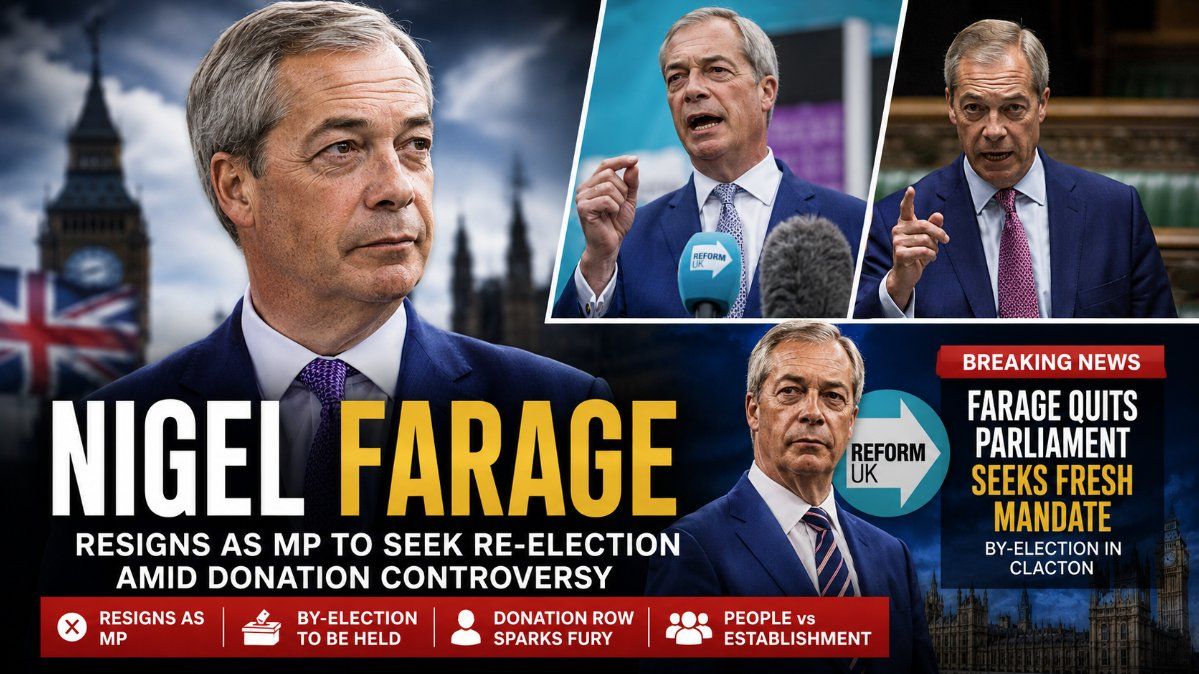
Nigel Farage Latest News: Reform UK Leader Resigns as MP to Fight By-Election Amid Donation Controversy
Nigel Farage resigns as MP and seeks a fresh mandate. Explore the latest news, donation controversy, Reform UK leadership, and biography.
Nigel Farage has once again become the center of British politics after announcing his resignation as a Member of Parliament and declaring that he will seek a fresh mandate from voters in a by-election. The dramatic move follows growing scrutiny over gifts and donations reportedly worth millions of pounds, allegations that have dominated headlines across the United Kingdom.
Rather than remaining in Parliament while investigations and political criticism continued, Farage said he wanted the public—not political opponents or Westminster institutions—to decide his future. Describing the upcoming contest as a battle between "the people and the establishment," the Reform UK leader argued that the by-election would give voters an opportunity to deliver their own verdict.
The announcement has triggered widespread debate across British politics. Supporters have praised the decision as an act of accountability and confidence, while critics argue that resigning and forcing a by-election is an attempt to shift attention away from the questions surrounding his finances and political conduct.
With media outlets, political analysts, and rival parties closely following every development, Nigel Farage has once again become one of the most talked-about figures in British public life. As the campaign begins, many voters are also revisiting his long political journey—from leading the Brexit movement to heading Reform UK and now seeking another electoral mandate.
In this article, we first examine the latest developments surrounding Farage's resignation, the controversy that led to his decision, reactions from across the political spectrum, and what could happen next before exploring his biography, political career, personal life, and legacy.
Why Is Nigel Farage Trending in 2026?
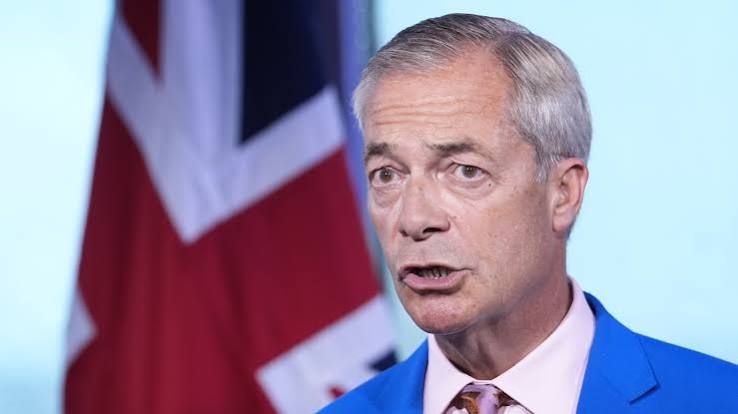 Nigel Farage is making headlines after announcing that he will resign as the Member of Parliament for Clacton and immediately contest the resulting by-election.
The announcement came after weeks of political pressure surrounding allegations linked to expensive gifts and donations that have attracted significant public attention. Although Farage has denied any wrongdoing, he said the continuing controversy had become a distraction from his work and from Reform UK's broader political agenda.
Instead of waiting for further parliamentary debate or investigations to shape public opinion, Farage said he wanted to return directly to voters. According to him, the by-election will allow the people of Clacton to decide whether they still have confidence in his leadership.
Calling the campaign a contest between "the people versus the establishment," Farage framed his decision as an opportunity to challenge what he described as coordinated attacks from political opponents and sections of the media.
The announcement immediately dominated political headlines, with commentators describing it as one of the biggest developments in British politics this year.
Nigel Farage Announces Resignation to Seek a Fresh Mandate
Farage confirmed that he would step down from Parliament before standing again in the by-election.
Speaking after making his decision public, he insisted that resigning was the most transparent way to address the ongoing controversy.
He argued that if opponents believed questions surrounding donations had damaged public trust, then voters should be given the opportunity to decide his future through the ballot box rather than months of political speculation.
Farage said he was prepared to defend both his reputation and his political record during the campaign, expressing confidence that constituents would judge him fairly once they heard his side of the story.
His announcement immediately reshaped the political conversation in Westminster, with parties beginning to prepare for what could become one of the most closely watched by-elections in recent years.
What Is the Donation Controversy About?
The latest political storm surrounding Nigel Farage centers on allegations involving gifts, financial support, and donations reportedly worth millions of pounds.
Questions have been raised about the nature of certain benefits he received, whether all relevant declarations were made correctly, and whether parliamentary rules were fully followed.
The controversy has prompted intense political debate and widespread media coverage, leading opponents to demand greater transparency regarding the financial arrangements.
Farage, however, has strongly rejected suggestions of wrongdoing.
He maintains that he has acted within the rules and has accused critics of attempting to damage both his reputation and Reform UK's growing political momentum.
According to Farage, resigning and fighting another election is the clearest way to demonstrate confidence in his position while allowing voters—not political institutions—to determine whether he should continue representing them.
At this stage, the allegations remain the subject of public and political scrutiny, and no final determination has been made regarding the claims.
Farage Says the Voters Should Decide
One of the central messages behind Nigel Farage's announcement is that democratic accountability should come directly from the electorate.
Rather than remaining in office while controversy continues, he argued that seeking another mandate would remove uncertainty and provide a clear answer about public confidence in his leadership.
Farage described the upcoming campaign as more than a local by-election.
According to him, it represents a wider political battle between ordinary voters and what he called Britain's political establishment.
That message has long been part of Farage's political identity, dating back to his campaigns during the Brexit years and continuing through his leadership of Reform UK.
Supporters have welcomed the decision, saying it demonstrates confidence and transparency.
Critics, however, argue that the resignation is a political strategy designed to transform questions about donations into a broader campaign about anti-establishment politics.
Reform UK Stands Behind Its Leader
Despite the controversy, Reform UK has continued to publicly support Nigel Farage.
Party members have described the resignation as a bold political move and insist that Farage remains the strongest figure capable of leading the party into future elections.
Several Reform UK representatives have argued that the by-election will become a test not only of Farage's personal popularity but also of public support for the party's wider policies on immigration, taxation, public spending, and government reform.
Party supporters believe the campaign could strengthen Reform UK's position nationally if Farage secures another convincing victory.
At the same time, rival political parties are expected to use the contest to challenge both Farage's leadership and the credibility of Reform UK's broader political message.
Political Reactions Begin to Grow
Farage's decision has produced sharply divided reactions across Britain's political landscape.
Supporters argue that voluntarily resigning and asking voters to deliver a fresh verdict reflects confidence in democratic accountability.
Some political commentators have also noted that few politicians choose to risk their parliamentary seats in this way.
Opponents, however, argue that the resignation does not remove the need for continued scrutiny regarding the donation allegations.
Several critics have suggested that the by-election campaign should not distract from questions surrounding financial transparency and parliamentary standards.
Political analysts believe the coming weeks are likely to focus on two separate issues: Farage's personal political future and the wider debate about ethics, accountability, and public trust in elected representatives.
Why This By-Election Matters
The upcoming contest is expected to attract national attention far beyond the constituency itself.
Although only one parliamentary seat is involved, many analysts believe the result could influence perceptions of Reform UK's political strength heading into future national campaigns.
A victory for Farage would allow him to argue that voters have rejected the criticism surrounding the donation controversy and renewed their confidence in his leadership.
On the other hand, a defeat would raise significant questions about both his political future and Reform UK's momentum.
For that reason, political parties, journalists, and voters across the United Kingdom will be watching the campaign closely over the coming weeks.
How the By-Election Could Reshape British Politics
Nigel Farage's decision to resign and immediately seek re-election has turned what would normally be a local by-election into a national political event. While the contest will determine who represents the Clacton constituency in Parliament, its significance extends far beyond a single seat.
Political observers believe the result could influence the direction of Reform UK and provide an indication of how voters currently view Farage's leadership. Since returning to frontline politics, he has played a major role in expanding Reform UK's support across the country, making this election an important test of both his personal popularity and the party's wider appeal.
For Farage, the campaign is not simply about retaining his seat. It is also about demonstrating that public support remains strong despite the controversy surrounding donations and financial disclosures.
Many analysts believe the outcome could shape political narratives heading into future national elections, with parties across Westminster watching developments closely.
Farage Defends Himself Against Allegations
Throughout the controversy, Nigel Farage has repeatedly rejected claims that he acted improperly.
He insists that he has followed the required parliamentary rules and has described the allegations as politically motivated. According to Farage, opponents are attempting to weaken Reform UK's growing influence by focusing attention on his finances instead of debating policy.
He has also argued that stepping down voluntarily shows he has nothing to hide. Rather than waiting for months of political arguments and media speculation, he believes asking voters to decide his future is the most democratic solution.
Farage maintains that his political opponents underestimated the public's ability to distinguish between allegations and proven wrongdoing. He has encouraged constituents to examine his record and make their own judgment during the by-election.
His message throughout recent interviews has remained consistent: the people of Clacton should decide whether he deserves to continue representing them in Parliament.
Opposition Parties Continue Their Criticism
While Reform UK has rallied behind Farage, rival political parties have continued raising concerns about the controversy.
Opposition politicians argue that public confidence in elected representatives depends on complete transparency regarding gifts, donations, and financial interests. They believe the questions surrounding Farage's finances deserve careful examination regardless of the by-election.
Some critics have suggested that resigning does not remove the need for accountability and that voters should consider the wider issues surrounding parliamentary ethics when casting their ballots.
Others have accused Farage of turning a serious matter into a political campaign designed to energize supporters by framing himself as an outsider fighting the establishment.
The differing viewpoints have ensured that the story remains one of the biggest political discussions in Britain this week.
Public Opinion Remains Divided
Reaction among the public has reflected the wider political divide surrounding Nigel Farage.
Supporters have praised his willingness to risk his parliamentary seat instead of remaining in office while facing continued criticism. Many argue that voluntarily returning to voters demonstrates confidence and respect for democratic accountability.
On the other hand, critics believe the decision does not answer the questions being asked about donations and financial transparency. They argue that investigations and public scrutiny should continue regardless of the election campaign.
Social media platforms have also become a major battleground, with thousands of users debating whether Farage's resignation represents political courage or calculated strategy.
Regardless of political opinion, most commentators agree that the announcement has successfully placed Farage back at the center of the national conversation.
Reform UK Sees an Opportunity
Senior figures within Reform UK believe the by-election could become an opportunity rather than a setback.
Party officials have emphasized that the campaign will focus not only on Farage but also on the issues they believe matter most to voters. These include immigration, economic growth, taxation, public services, energy policy, and government reform.
Reform UK hopes that national attention surrounding the by-election will increase public awareness of the party's wider agenda.
Campaign organizers are expected to highlight Farage's experience, leadership, and long-standing criticism of the political establishment while arguing that the controversy has been exaggerated by opponents.
If the party secures another victory in Clacton, Reform UK believes it will strengthen its credibility ahead of future political contests.
What Happens Next?
Following his resignation announcement, preparations for the by-election are expected to begin quickly.
Political parties will select candidates, campaign teams will organize local events, and voters will soon begin hearing competing arguments from across the political spectrum.
Farage is expected to spend much of the campaign defending both his political record and his handling of the donation allegations. At the same time, rival candidates are likely to focus on the questions that triggered the resignation in the first place.
The campaign is expected to attract significant media coverage, with national broadcasters and newspapers following developments throughout the election period.
Because of Farage's profile and Reform UK's growing influence, even small developments during the campaign are likely to generate widespread public discussion.
Why This Story Matters Beyond Nigel Farage
Although the immediate focus remains on Nigel Farage, the controversy has also reopened wider discussions about transparency, political funding, and accountability in British politics.
Questions surrounding gifts, donations, and financial declarations have become increasingly important issues for voters across different political parties.
Many constitutional experts argue that maintaining public trust requires elected representatives to be open about financial relationships and external support.
At the same time, others believe politicians should not be judged solely on allegations before investigations reach clear conclusions.
The debate surrounding Farage therefore extends beyond one individual. It highlights the ongoing challenge of balancing political accountability, public confidence, media scrutiny, and democratic fairness.
As the by-election approaches, these broader issues are expected to remain central to public discussion.
A Defining Moment for Farage's Political Career
Nigel Farage has experienced many dramatic moments throughout his decades in politics, from leading the UK Independence Party during the Brexit campaign to later becoming the face of Reform UK.
His latest decision to resign and seek another public mandate may prove to be one of the most significant chapters of his career.
If voters return him to Parliament with a strong majority, Farage is likely to argue that the electorate has rejected the allegations against him and renewed its confidence in his leadership.
If the result goes against him, however, it could reshape both his own political future and the direction of Reform UK.
Either way, the upcoming by-election is set to become one of the most closely watched political contests in Britain this year, with consequences that may extend well beyond a single parliamentary constituency.
Who Is Nigel Farage?
Nigel Farage is one of the most influential and controversial politicians in modern British history. Best known for his role in the Brexit movement, he has spent more than three decades campaigning for major constitutional and political change in the United Kingdom.
Throughout his career, Farage has built a reputation as an outspoken politician who challenges the traditional political establishment. Whether people agree with his views or strongly oppose them, few would deny the impact he has had on British politics.
From helping transform the Brexit debate into a national movement to leading Reform UK in recent years, Farage has remained one of the country's most recognizable political figures.
Today, he continues to shape political discussions through Parliament, television appearances, public speeches, and national campaigns.
Early Life and Education
Nigel Paul Farage was born on April 3, 1964, in Farnborough, Kent, England.
He attended Dulwich College, one of London's well-known independent schools. Unlike many senior British politicians, Farage chose not to attend university. Instead, after completing his education, he entered the financial sector and began working as a commodities trader in the City of London.
His experience in financial markets exposed him to international trade and economic policy, subjects that would later become central to his political arguments regarding Britain's relationship with the European Union.
Before entering politics full-time, Farage spent several years building a successful career in commodity brokerage.
Entering Politics
Nigel Farage's political journey began in the early 1990s after becoming increasingly opposed to Britain's growing integration with the European Union.
In 1993, he became one of the founding members of the UK Independence Party (UKIP), a political party established with the goal of withdrawing the United Kingdom from the European Union.
At the time, UKIP was considered a small political movement with limited national influence.
Farage spent years campaigning across the country, speaking at public meetings, participating in debates, and gradually expanding the party's support.
His energetic campaigning style and willingness to challenge mainstream political parties helped transform UKIP into a significant force within British politics.
The Brexit Campaign That Changed British Politics
Nigel Farage became internationally known during the campaign leading to the 2016 Brexit referendum.
Although he was not part of the official Vote Leave campaign leadership, he remained one of the most visible supporters of Britain's departure from the European Union.
Through speeches, media interviews, public rallies, and televised debates, Farage argued that leaving the EU would allow the United Kingdom to regain greater control over immigration, borders, trade, and national sovereignty.
When the referendum resulted in a majority voting to leave the European Union, many supporters credited Farage for helping keep the issue at the center of national politics for more than two decades.
The Brexit campaign transformed him from a well-known British politician into an internationally recognized political figure.
Life After Brexit
Following the Brexit referendum, Farage remained active in public life.
He continued commenting on British and international politics through television appearances, newspaper columns, radio programmes, and public speaking engagements.
He later launched the Brexit Party, which focused on ensuring that the United Kingdom fully implemented the referendum result.
As Britain's political landscape evolved, the party was restructured and eventually became Reform UK, with Farage returning to frontline leadership.
Under his leadership, Reform UK has focused on issues including immigration, taxation, government spending, public services, economic reform, energy policy, and political accountability.
His return to Parliament marked another major chapter in his political career.
Nigel Farage's Leadership Style
Supporters often describe Nigel Farage as a direct and confident communicator who speaks openly about issues that many voters believe established parties avoid.
His speeches are usually straightforward, energetic, and centered around themes such as national sovereignty, democratic accountability, lower taxes, controlled immigration, and reducing government bureaucracy.
Critics, however, argue that his political style is highly confrontational and that many of his positions have contributed to increasing political polarization.
Regardless of differing opinions, Farage remains one of Britain's most effective political communicators and continues attracting significant media attention whenever he makes major announcements.
Personal Life
Away from politics, Nigel Farage has generally kept parts of his private life separate from his public career.
He has been married twice and is the father of four children.
Outside Parliament, Farage enjoys activities such as fishing, aviation, and spending time in the countryside.
He has also written about politics, regularly appears in broadcast media, and remains one of Britain's most recognizable political commentators.
Although politics dominates public discussion surrounding him, those close to him often describe him as someone who enjoys a quieter lifestyle when away from campaigning and media appearances.
Nigel Farage's Estimated Net Worth
Nigel Farage has earned income from several different sources throughout his career.
In addition to his work as a politician, he has received earnings from broadcasting, journalism, public speaking, publishing, and business activities.
Various public estimates suggest his net worth is in the range of £4 million to £6 million, although no official figure has been confirmed.
His financial affairs have attracted renewed public attention following the recent controversy surrounding donations and gifts, making transparency an important topic during the current political debate.
Interesting Facts About Nigel Farage
- His full name is Nigel Paul Farage.
- He was born on April 3, 1964, in Farnborough, Kent.
- He attended Dulwich College but did not attend university.
- Before politics, he worked as a commodities trader in London.
- He helped found the UK Independence Party (UKIP) in 1993.
- He became one of the leading public faces of the Brexit movement.
- He later founded the Brexit Party, which evolved into Reform UK.
- He returned to Parliament after winning the Clacton constituency.
- In 2026, he resigned as MP to contest a by-election following scrutiny over donations and gifts.
- He remains one of the most influential and debated politicians in modern British politics.
Frequently Asked Questions (FAQs)
Why is Nigel Farage in the news?
Nigel Farage is making headlines after announcing his resignation as the MP for Clacton to seek re-election in a by-election amid scrutiny over gifts and donation-related allegations.
Why did Nigel Farage resign as an MP?
Farage said he wanted voters to decide whether they still had confidence in him rather than allowing the controversy to dominate political debate. He described the by-election as a contest between "the people and the establishment."
Has Nigel Farage been found guilty of wrongdoing?
At the time of writing, Farage has denied any wrongdoing. The allegations remain under public and political scrutiny, and no final conclusion has been reached.
Which political party does Nigel Farage lead?
Nigel Farage is the leader of Reform UK.
What is Nigel Farage best known for?
He is best known for leading campaigns supporting Brexit and for his long-standing opposition to Britain's membership of the European Union.
How old is Nigel Farage?
Nigel Farage was born on April 3, 1964. As of 2026, he is 62 years old.
What is Nigel Farage's estimated net worth?
His estimated net worth is believed to be between £4 million and £6 million, although no official figure has been confirmed.
Nigel Farage Quick Facts
| Detail | Information |
|---|---|
| Full Name | Nigel Paul Farage |
| Date of Birth | April 3, 1964 |
| Age (2026) | 62 Years |
| Birthplace | Farnborough, Kent, England |
| Nationality | British |
| Profession | Politician, Broadcaster |
| Political Party | Reform UK |
| Education | Dulwich College |
| Children | Four |
| Estimated Net Worth | £4–6 Million (Estimated) |
| Current Status | Resigned as MP and seeking re-election |
Final Thoughts
Nigel Farage's decision to resign from Parliament and seek a fresh mandate has created one of the most significant political stories in the United Kingdom this year. Supporters view the move as a demonstration of confidence in the democratic process, while critics argue that questions surrounding donations and financial transparency should continue to receive close scrutiny.
Whatever the outcome of the upcoming by-election, the campaign is likely to have implications far beyond Clacton. It will test public confidence in Farage, measure the momentum of Reform UK, and contribute to wider debates about accountability, political ethics, and the future direction of British politics.
As events continue to unfold, Nigel Farage remains one of the most influential figures in the country's political landscape, ensuring that every development in this story will continue to attract national and international attention.